To be fair, here's the complete list of companies in the known universe that don't try to avoid taxes or regulation:
[error data not found]
There's a cost of moving. California's taxes and regulations are bad, bad enough to force many out, but not all. If things continue on their present course, even Google and Amazon, who personally like the political climate there, will have to start looking elsewhere.
Most startups don't care about taxes or regulations. Taxes are a rounding error (or literally zero) when you're small and not making any money, which will be the first several years of a startup's life. When you get big you can hire an army of lawyers and accountants to keep all your money in Ireland and avoid them. Regulations just get ignored. When you're small, you're too little a fish to go after; the regulators are busy suing Uber and Lyft and Facebook and Google. When you get big, you can hire an army of lobbyists and PR people to change the regulation, just like Uber and Lyft did.
> Most startups don't care about taxes or regulations.
Yes, but they care about cost. And the reason that everything is so expensive in California is regulation and taxes. Acting like these are separate things is not a valid assumption.
I don't believe that the reason everything is so expensive in California is regulation and taxes. Here's why:
The North Coast (Eureka, Crescent City) and Central Valley (Chico, Fresno, Modesto, Bakersfield) are under the same regulatory and tax regime as the rest of California. How expensive is Eureka? Houses average $300K [1]. Restaurant meals are about $10-12. [2][3] How expensive is Bakersfield? Houses are about $250K [4], meals are about $11 [5]. In other words, they're not much different from the rest of America.
I think that much of the contemporary political narrative gets the causality wrong. The Bay Area and LA are expensive because they are home to global monopolies that funnel cash from all over the world into a small region. There's not much land available in these metros, there's a lot of money floating around, there are a lot of people who want to move in to get a piece of this money, and so they bid up the prices of scarce goods. Regulation comes later, to curb the power imbalances from having corporations with more resources than many nation-states, and taxes come so that the state can get a piece of the huge cash flows coming in.
But the primary driver of cost-of-living is being the sink for the disposable income of 7B consumers. Eureka's primary industry is timber, and Bakersfield's is oil. Both of these are commodity markets where the money goes elsewhere in the value chain. Not so with tech and entertainment.
You know what they don't have, insane zoning restrictions that prevent housing. For example, the Houston MSA, which has almost no zoning restrictions is within 90% of the population (and 80% population density) of the Bay Area 9 county MSA with an average house price of... $249K at 2,000 sq ft.
And there's a reason I left Bakersfield and moved to Austin. It's because PG&E energy prices are benchmarked at Bay Area temperatures, and they have progressive pricing. Because I had a server rack in a garage in super hot (110+ F) summers, I was paying over $600 a month in energy bills in a tiny 1000 sq foot house in a ghetto. If I had lived in a 4 bedroom house, I would have paid less in energy.
And just on a secondary, personal note. Houses in Houston are way, way nicer than houses in San Jose, Oakland, San Francisco etc. This is one of those things where I know that people have just not experienced living in other places when I hear quality arguments around housing, food, or amenities.
It's just not that nice in San Francisco. Seriously. The food is just downright bad in quality and variety compared to even Austin, much less Houston. The housing stock is dreadful. Service is slow. The quality of things in Houston is better than the Bay Area, irrespective of cost.
I'll grant you that Bay Area zoning is fucked up. That's under local jurisdiction, though: the state keeps trying to override local zoning requirements to build more housing and keeps getting shot down at the ballot box.
My sister lives in Houston (well, Sugarland technically), so I'm well acquainted with the metro area. It's a very different lifestyle. The housing stock in the Bay Area is uniquely terrible - most of it is 3BR Eichlers that were mass-produced in the 60s. But people don't spend all that much time indoors. Pre-COVID, my wife and I were out every weekend to museums, hiking, the beach, picnics, restaurants, etc. There are 4 parks within walking distance of my home, 2 commercial downtowns, then the mountains are 5 minutes away, the beach 20, SF 30, SJC 30, the Bay 5, etc. And the weather cooperates - it's a consistent 70 and sunny for 8 months out of the year. Meanwhile, my sister's place is 50% larger for a quarter of the price - but it better be, because it's 100 degrees with sweltering humidity for 8 months out of the year. They need to take a highway onramp to get anywhere. They have no friends, because everyone they meet is so far away. Downtown Houston is a little different (my sister went to Rice, Rice Village is pretty nice), but also a completely different story in terms of housing prices - you start seeing million dollar homes once you get to the downtown areas of Houston.
Different strokes for different folks. We could've purchased my sister's house for cash at the time they bought it. I floated the idea by my wife, and she was like "But then we'd have to live in Houston!"
Plenty of company CEO’s know little to nothing about taxes and simply hand relevant details to a different firm. Growth gives exponential returns, taxes give linear returns which is why they can be ignored for years. Regulations are similarly irrelevant for most companies, as long as the competition needs to play by the same rules they tend to zero out as just a cost of doing business.
> taxes give linear returns which is why they can be ignored for years
This isn't true at all. The effect of taxes compound just like anything else. E.g. if Warren Buffet had originally incorporated Berkshire as a Bermuda-based reinsurer, he'd be worth over $400 billion today. If he didn't structure it as an insurer at all he'd only be worth $20 billion.
Tax savings compound at whatever the long-term ROE of the corporate entity. Therefore tax arbitrage is most important for hyper growth companies.
When you’re growing at even 10% per month the difference between 50Billion and 400 billion in 50 years is a rounding error on a rounding error. Further, diminishing returns means your stuck investing in ever less profitable operations as you grow. These will often lose money, just look at say Microsoft or Google to see how little an extra 100 billion 10 years ago would give them now.
Nobody is saying they don’t have any upside, but as always it’s the opportunity cost that kills you.
Corporate entities have to make quarterly payments. Let's assume you're a $10 million company with 10% monthly ROE/growth. Paying an additional 9% in California corporate tax rates will result in the loss of a billion in market cap within five years. Literally a third of the terminal value of the startup.
Point taken about diminishing marginal returns. But you can see that even taking that into account, the impact of lax tax planning for shareholders is humongous. (Plus many startups are in winner-take-all markets, and effectively have increasing returns to scale.)
The opportunity cost is real. Tax arbitrage will take some amount of bandwidth. But it often takes much less effort to raise cash by minimizing taxes than it does to raise additional equity funding. The former can mostly be done by the CFO in the background, whereas the latter requires the attention of the founders.
That a 9% income tax in California corporate tax rates are on profit. A profitable startup has unlimited runway so the classic X month of runway company is facing ~0 income taxes.
Further it assumes your capital constrained, which might apply to some fast growing business but if your the magical unicorn of a profitable fast growing growing company then capital is the easiest problem to solve. Worst case you might trade a little extra equity, but again that’s linear dilution often based on growth at the current rate.
PS: If your growing 10% per month it takes 6 years to go from 1 million per year in revenue to 1 billion per year in revenue. It’s very fast, but hardly instantaneous. Keeping that up for 12 years means 1 trillion in revenue per year which is extremely rare. Growth will slow eventually, and when it does there are a huge number of things to optimize.
Some folks in my network are ex-Oracle and my understanding is that the company is run by the CFO and a huge group of MBAs. Any company where the bean counters are at the helm are optimizing for things like quarterly earnings, tax savings like you said, etc. This is the stage where they milk whatever they can out of a dying cash cow. There’s nothing interesting to me about this flavor of capitalism and I don’t think it’s something America should be proud of producing. Conversely, technology innovation and the entire ecosystem in Silicon Valley is really special and almost irreplicable.
Note: I have nothing against MBAs, I just don’t think it’s appropriate for them to have the loudest voice at a non-financial institution. They serve a critical role but it’s a supporting one and not suitable to leadership / company direction.
Growth at geriatric tech companies like IBM, HP, Oracle, etc. is largely inorganic, driven by well-negotiated acquisitions of smaller B2B software companies.
It takes MBAs to do this sort of work, and while it isn't for me, I don't think it's the worst business model out there.
You don't need an MBA for the financial/high level business knowledge requirements (though many people involved in this have one), but the people networks that MBA programs provide are very beneficial in getting connected to the right person at the right company.
The main value of an MBA is the network. I think lower tier schools can work well if they are tight knit and the graduates tend to stay local to the school. The top tier schools will just have people making more money at more "prestigious" companies.
I've seen a lot of tech companies with CFOs as leaders and you're 100% right. They have a certain set of tools and fix those types of problems, which usually aren't the ways to lead tech companies.
I think every company should be lead by a person who has a strong background in the company's main role. I have seen finance background CEOs get replaced and the Company began to thrive again. Its not a bad investing idea!
He's opening new Tesla facilities in Texas, but currently he hasn't formally announced he's completely pulling operations out of Texas, although he's threatened to in the past.
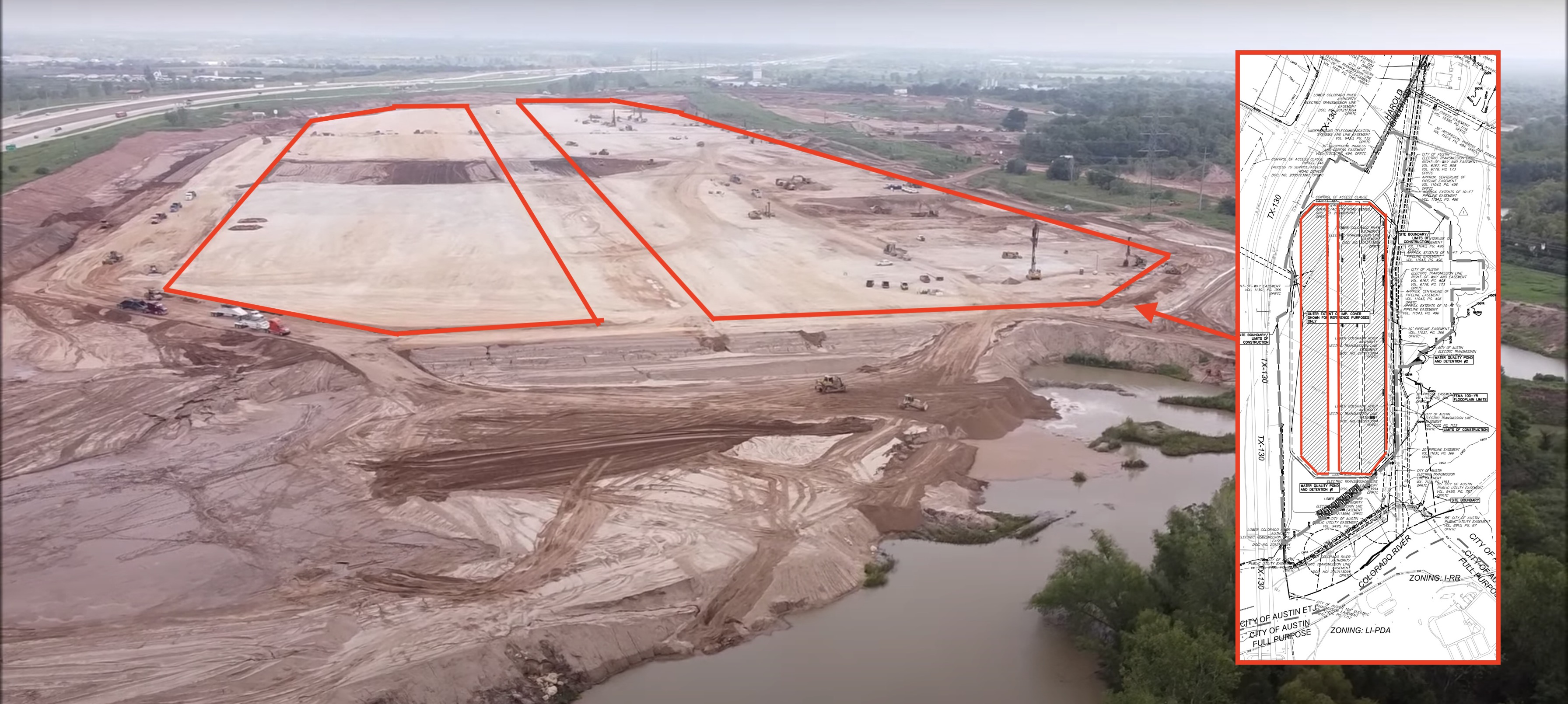
That size comparison doesn't actually show a comparison. It only has the footprints for the other factories, and the entirety of the land purchase for the texas factory. What a bizarre thing!
> Your second statement struck me, and I was curious how the manufacturing sectors compare for California vs Texas.
And Wall Street was great in New York until they moved to Florida, North Carolina, and Hawaii... and Oil headquarters were huge in California until they moved to Texas... and Big Auto was big in Michigan until they moved to the South and on and on.
What is so mind-boggling about all these people not seeing the trends is acting like what is is what has to be. There's no divine right for these companies to remain in California. It has a terrible business climate. Were it not for oil, agriculture, and defense in parts of CA the Bay Area loathes, there would be very little actual "stuff" produced in California. Software has no geographic attachment to the land like ag or oil, so there's no reason they have to be forced to the Central Valley. They can just leave.
It's also a lot further away from the Mexico border, where an awful lot of car parts are manufactured. A whole lot of those parts are already flowing through TX as it is, easier to dip into the existing streams than build new supply chains.
Also a lot of bigger, tech friendly cities -- Dallas, Austin, and Houston is poised to overtake Chicago as the 3rd largest city in the US within a decade or two.
Kanasas may be similar in terms of taxes and political climate (unions) but all its really got going for it is empty space. Ditto for much of the rest of the Midwest.